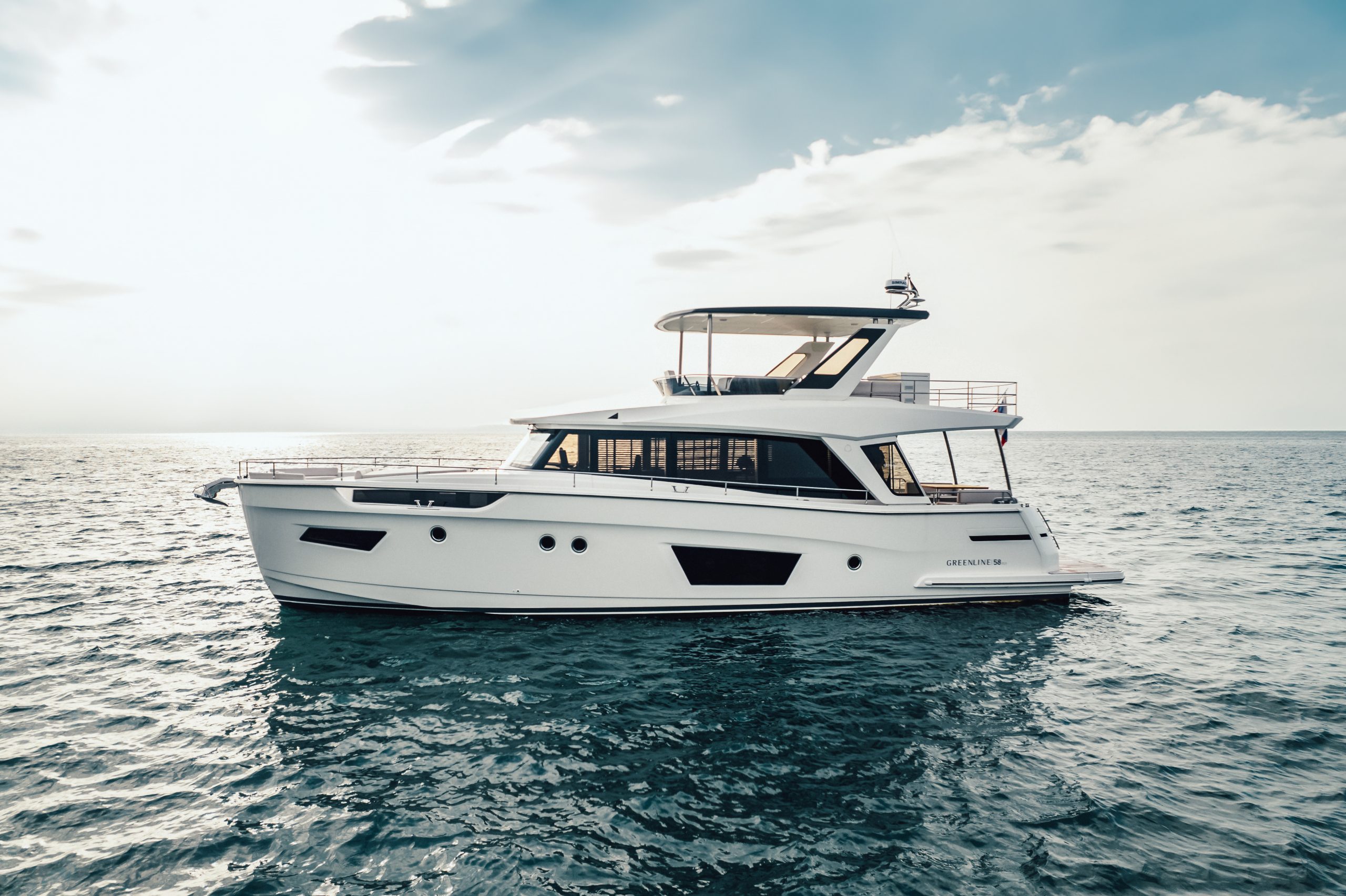
Eight Years as a Greenline Dealer: What We Have Learned
I became a Greenline dealer in 2017. I did not do it because hybrid was a trend. I did it because I had spent 30 years in the diesel world and I could see that something was changing.
The first time I drove a Greenline at anchor with the diesel off, I understood it. Not the technology — I already understood the technology. I understood why it mattered to buyers. That was the moment I committed.
Since then we have placed over 100 Greenlines with buyers across the United States. Greenline has delivered around 1,500 hulls worldwide since they launched the first hybrid yacht in 2009. We have sold more of them than any other dealer in the world. I mention that not to boast. I say it because that experience has taught me things you cannot learn from a brochure.
This is what eight years of selling hybrid yachts actually looks like.
“Some buyers come in already decided. Most come in skeptical. The sea trial is where it changes. I have never had a buyer do a proper sea trial on a Greenline and walk away unimpressed. Not once.”
Where Greenline Started
Greenline was founded in Slovenia in 2008. In 2009 they launched the Greenline 33 at the Düsseldorf Boat Show — the first production hybrid yacht from any builder, anywhere. It won European Powerboat of the Year in 2010. It sold to customers in 28 countries.
That is no small thing. To take a completely new propulsion concept, bring it to production, and sell it to 550 owners across 28 countries in the first model alone — that is a proof of concept that no other builder had achieved at that point.
The company went through a financial restructuring in 2015 when SVP Yachts took over operations. That is a part of the history I am transparent about. What came after that restructuring is a decade of steady, serious development. The current generation of Greenline hybrids is not the same product as the 2009 original. The 6G hybrid drive system, the LiPo battery banks, the solar integration, the hull efficiency — all of it has been refined over multiple generations. The more they refined it, the better the real-world results became.
What Changed Across the Generations
The Drive System
The current 6th Generation hybrid drive — what Greenline calls the H-Drive 6G — is a genuine parallel hybrid. The diesel and the electric motor are both mechanically connected to the same shaft. When you run on diesel, the electric motor becomes a generator and recharges the battery bank. Solar panels charge it continuously. The system is always working, always recovering energy.
I have watched this system evolve from the early generations. The integration is much tighter now. The transitions between modes are seamless. The software management is more intelligent. One owner who bought a Greenline 45 in 2019 and upgraded to a 2024 model told me it felt like a different category of product. That is not marketing language. That is what I hear from real owners.
The Battery Technology
Greenline uses LiPo batteries — lithium polymer — rated for approximately 2,000 cycles. That is a meaningful service life in real-world use. The energy density has improved with each generation, which means more range in the same footprint. The solar panel output has also increased — the current 45 Fly ships with panels producing meaningful daily charging capacity even on overcast days.
I always tell customers: the battery is not a mystery. You treat it like any other system on the boat. You charge it properly, you do not let it sit fully discharged for extended periods, and you service it on schedule. Owners who have followed that approach have had excellent results.
The Range
Greenline builds nine models today, from the 39 to the 58 Fly. Every single model is available with hybrid propulsion. That range is important because it means I can fit a buyer at almost any budget and size requirement into a Greenline. The 39 is the right boat for a couple doing coastal cruising. The 58 Fly is a serious passagemaker with full-headroom interior volume and a flybridge that competes with much larger diesel boats.
In 2023 Greenline also expanded into the superyacht segment with the GX brand — a 42-metre hybrid superyacht currently in build. That is a signal of where the technology is going. Hybrid propulsion is no longer just for the 40 to 60 foot range.
“We have placed Greenlines from the 39 to the 58. Every single model teaches me something new about how buyers use these boats. The customers who get the most out of a Greenline are the ones who change how they cruise after they buy it. They spend more time at anchor. They move slower. They come back from trips more rested than they left.”
Who Buys Greenlines from Us
After over 100 deliveries, I know the profile well.
The most common buyer profile for a Greenline is a buyer who is upgrading from a conventional motoryacht in the 38 to 50 foot range. They have been boating for years. They know what they like. They have started to find the generator noise and the fuel bills increasingly annoying. Someone — a friend of theirs, a dock neighbor, a broker — mentioned Greenline to them. They come to me skeptical but curious.
That customer almost always buys.
The second profile is the new buyer entering boating specifically because hybrid technology made it attractive to them. As the electric vehicle market has normalized electric propulsion on land, this buyer type has appeared in the marine market in growing numbers. These customers are often first-time boat buyers. They do extensive research before they call me. They arrive with detailed technical questions. I respect that. As I said, the customer who asks hard questions is the customer who becomes a committed owner.
The third profile is the liveaboard. These are the customers for whom hybrid delivers the most dramatic quality of life improvement. Running hotel loads indefinitely from solar and battery, no generator, no diesel smell — for someone living on their boat full time, this is not a feature. It is a different life.
What Eight Years Has Taught Me
The Sea Trial Closes More Deals Than I Do
I am a good broker. I know how to explain a product. But no explanation I have ever given closes a Greenline sale the way a proper sea trial does. I mean a real sea trial — not a dock walkthrough. Time underway at low speed on electric only. The difference between electric mode and diesel is something you feel in the first five minutes.
Every time. Without exception. The customer gets off that boat different from how they got on.
Buyers Underestimate the Generator Story
When I describe the hybrid system to a new buyer, they focus on fuel savings. That is the number they understand — 20 to 30 percent less diesel per season. That is real and I will not minimize it.
But the story that actually changes behavior is the generator story — and most buyers miss it completely at first. On a conventional motoryacht, you carry a dedicated diesel generator for house loads: refrigeration, air conditioning, water heating, charging, lighting. That generator has a purchase cost, a maintenance schedule, fuel consumption, and a service life. It runs constantly at anchor. It runs through the night.
On a Greenline, there is no traditional standalone generator. The eUnits — the electric motors in the hybrid drive — function as generators when the main diesel engines are running, continuously recharging the LiPo battery bank. Solar panels do the same at anchor and underway. The battery bank and inverter system handle all house loads. The result: no genset capital cost, no genset maintenance, no genset fuel burn, and no generator running through the night at anchor. For a buyer doing the math on total cost of ownership, that changes the numbers significantly. For a buyer trying to sleep on their boat, it changes everything.
The Service Network Matters More Than Buyers Expect
Greenline is built in Slovenia. The major systems — Yanmar engines, the hybrid drive electronics, the battery management system — all have established U.S. service networks. We have never had a buyer stranded because a part was unavailable. We have yet to encounter a warranty situation that could not be resolved through channels I knew personally.
This matters more than it sounds. As more time passes after a purchase, as more important service becomes. A buyer who has owned their Greenline for five years cares much more about service access than they did on the day they signed the contract. I plan for that conversation on day one.
The Owners Who Use Them Most Get the Most Out of Them
This sounds obvious. But what I mean is more specific. The owners who change how they cruise — who slow down, who anchor more, who take the slower route because they can — those owners come back to us as the most satisfied buyers we have worked with. The hybrid system rewards a certain style of cruising. Buyers who discover that style through the boat rarely go back to diesel.
“We match reality to people’s dreams. That is what Greenline allows us to do. A buyer comes in wanting silence, sustainability, and lower running costs. I put them on a Greenline and show them that those things are not dreams anymore. They are available right now, in a production boat, at a reasonable price.”
If You Are Considering a Greenline
Come for a sea trial. Not a boat show walkthrough — a real sea trial on the water, underway on electric.
We have current inventory in Fort Lauderdale and across our network. We have new deliveries available. And we have eight years of experience placing these boats with exactly the kind of customer who gets the most out of them.
Browse current Greenline inventory or call us at 954.642.2080. Ask about sea trial availability in your area.
The Greenline 45 Fly is the model I recommend most frequently for the Great Loop. The LOA and beam fit most locks comfortably, the flybridge gives excellent visibility for navigating rivers and channels, and the hybrid system delivers the generator reduction that makes months-long liveaboard cruising genuinely comfortable. We have had customers complete the full Loop with under 150 generator hours — on a conventional motoryacht the same route would put 1,000 or more hours on the genset.
The H-Drive 6G is a sixth-generation parallel hybrid system. The diesel engine and electric motor are both mechanically connected to the propeller shaft. At low speeds and in marina environments you run on electric only — near-silent, zero emissions. At cruise speed the diesel takes over and runs at optimal efficiency. When running on diesel, the electric motor functions as a generator and recharges the LiPo battery bank. Solar panels on the hardtop charge the bank continuously. The system manages mode transitions automatically; the owner can also select modes manually.
YSI currently offers new Greenline models across the full range: the Greenline 39, 40, 42, 45 Fly, 45 Coupe, 48 Fly, 48 Coupe, 58 Fly, and 58 Coupe. All models are available with the parallel hybrid drive system. Availability and delivery windows vary — contact us directly for current stock and order lead times. We carry inventory in Fort Lauderdale and can arrange sea trials across our network of offices in Palm Beach, Cape Coral, Annapolis, and Chicago.
Greenline models carry CE Category B certification, which covers offshore use in significant sea conditions. The hybrid system uses production-grade components with U.S. service support. We have placed Greenlines with customers who have completed extended offshore passages including Gulf Stream crossings, Bahamas cruising, and Caribbean passages. The boats are well-suited for this use when properly outfitted and maintained.
The main differences are propulsion, noise, and running costs. A Greenline of equivalent LOA typically offers comparable interior volume and performance, with 20 to 30 percent lower fuel consumption, dramatically reduced generator hours, and near-silent operation at anchor. The hybrid premium at purchase is real — typically $30,000 to $50,000 over an equivalent diesel model — but owners who use their boats regularly typically recover that through fuel and maintenance savings within 7 to 10 years.